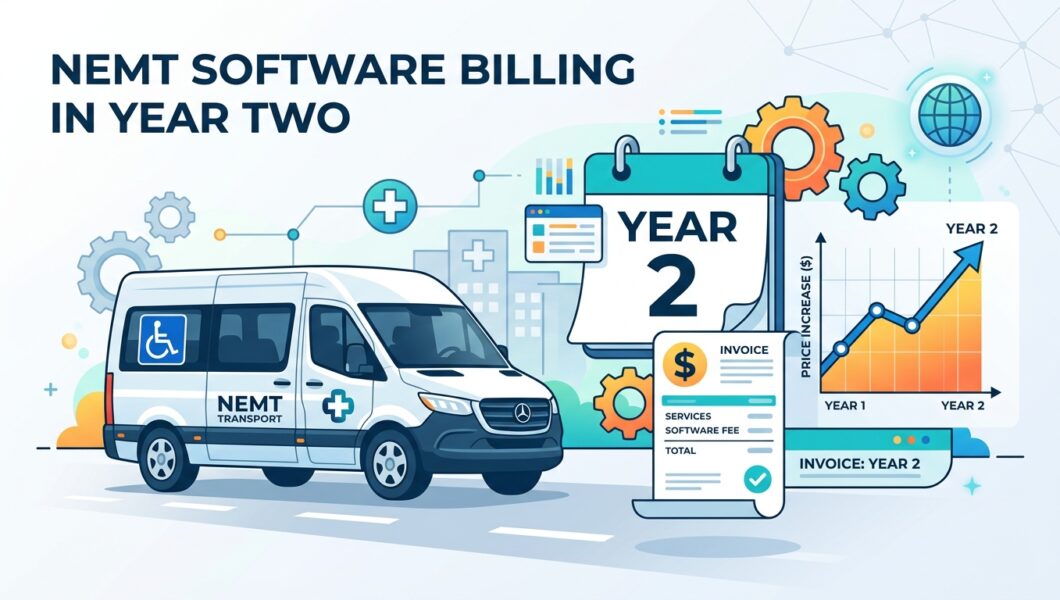
Most conversations about NEMT software pricing focus entirely on the number you sign at. Almost nobody talks about what happens when that first contract term ends — and that’s exactly when a lot of providers get an unpleasant surprise, because year-one pricing and year-two pricing aren’t always the same conversation.
Why Year One Isn’t a Reliable Preview
Introductory the NEMT software pricing is common in this market — a discounted rate, a waived setup fee, or a promotional term to win a new account. None of that is dishonest, but it does mean the price you signed at may not be the price the relationship settles into. If you didn’t ask what happens at renewal, you may find out for the first time when the new invoice arrives.
What Actually Moves the Price at Renewal
Standard rate increases. Some contracts include an automatic annual increase, often tied to a fixed percentage or an index. This should be spelled out in the contract itself, but it’s easy to skim past during the initial signing when you’re focused on the headline monthly number instead of the renewal terms.
End of introductory or promotional pricing. If your first-year rate was discounted to win your business, year two often reverts to standard pricing — sometimes a meaningful jump, not a small adjustment.
Vehicle count changes. Growth is good news for your business, but on a per-vehicle pricing model, it’s also a straightforward reason your bill goes up. This isn’t a hidden cost so much as one that’s easy to under-plan for if you’re not tracking it against your growth projections.
Add-on creep. It’s common to add a module or two after go-live — an extra broker integration, a reporting upgrade, additional support tier — each reasonable on its own, but collectively they can move the total further from the number you originally budgeted against.
Renegotiated terms based on usage. Some contracts adjust pricing based on actual trip volume or vehicle count observed over the first year, rather than the estimate used at signing. If your actual usage came in higher than projected, the renewal quote may reflect that.
The Questions Worth Asking Before You Sign, Not After
- Is any part of this year-one price introductory, and what does the renewal rate look like?
- Is there an automatic annual increase built into the contract, and what’s the percentage or index it’s tied to?
- If I add vehicles or broker integrations mid-contract, when does that show up on my bill — immediately, or at renewal?
- Can I get the renewal terms in writing now, rather than finding out at the end of the term?
A vendor confident in their long-term pricing will answer these clearly during the sales process. Vague answers here are worth treating as a signal, not an oversight.
Planning for the Real Number, Not Just the First One
The smartest way to budget for NEMT software isn’t to plan around the year-one quote — it’s to ask for a two- or three-year projection based on your expected growth, and to get the renewal terms in writing before you sign anything. That number, not the introductory rate, is the one that actually determines whether the software fits your budget over time.
RoutingBox is upfront about renewal terms and rate structure at the time of signing, rather than leaving providers to find out what year two looks like when the new invoice shows up.
Ask About Your Full Contract Term
Before signing anywhere, talk to RoutingBox about what your pricing actually looks like in year two and year three, not just the number on the first invoice.