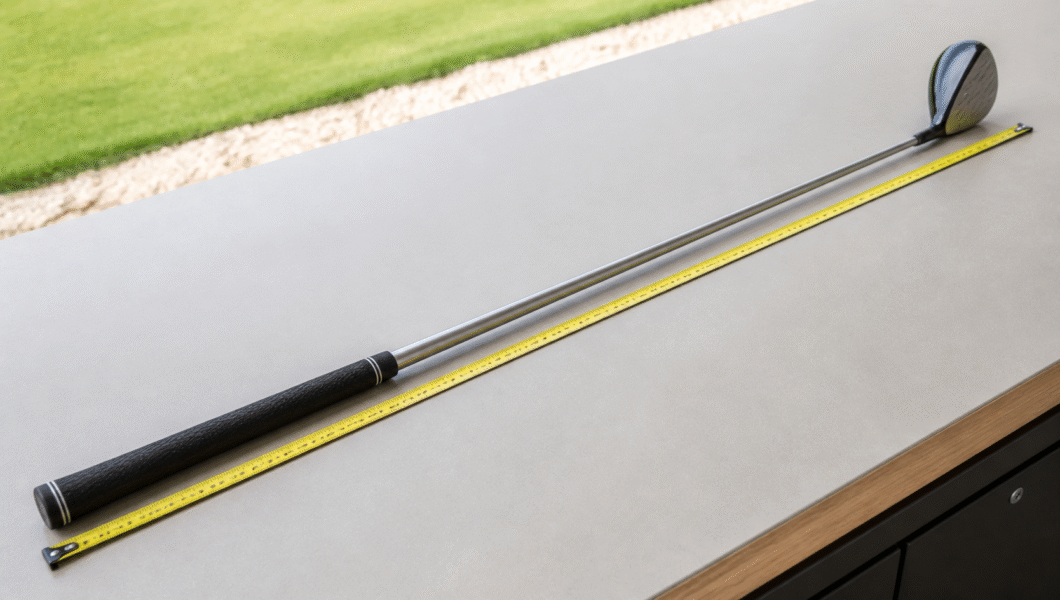
Golf club length is one of the most overlooked parts of a golf setup. A club that is even half an inch too long or too short can affect your posture, ball contact, and accuracy.
Whether you’re buying used clubs, comparing a driver with your old one, or simply checking the clubs in your bag, knowing how to measure golf club length gives you useful information.
In this guide, we’ll explain how to measure golf club length correctly, what tools you need, and how the process differs for drivers, irons, wedges, and putters. We’ll also cover the difference between shaft length and club length, how to measure yourself for golf clubs, and what to do with your measurements.
What You Need to Measure Golf Club Length
Before you begin, gather a few simple tools:
- A rigid ruler or steel tape: Use one that is at least 48 inches long. Avoid flexible sewing tapes because they can bend around the shaft and grip, adding measurement errors.
- A hard, flat surface: A garage floor, concrete floor, or hardwood floor works well. Carpet can allow the club’s sole to sink or tilt.
- A pencil or strip of tape: Use it to mark the point where the ruler meets the grip.
- A second person (optional): Someone can help hold the club in the correct position while you read the measurement.
A dedicated 48-inch golf club ruler with an angled heel stop is the preferred tool for professional club fitters. However, you can still get an accurate measurement at home without one.
How to Measure Golf Club Length: Step by Step
The playing-position method is commonly used by clubmakers and fitters for everyday club measurements.
Follow these steps to measure your golf club:
- Place the club in its playing position. Rest it on a hard, flat floor with the middle of the sole touching the ground. Make sure the toe and heel sit level.
- Position the ruler. Place the zero end of the ruler on the floor just behind the heel of the club.
- Align the ruler with the shaft. Run it along the back of the shaft, keeping it close to the shaft all the way up.
- Read the measurement. Check the number at the edge of the grip cap, rather than the highest point of the cap.
- Record the result. Write down the measurement to the nearest 1/8 inch, then measure again to confirm the reading.
One of the most common mistakes is allowing the club to lean toward the toe or heel.
If the toe is raised, the grip end drops and the measurement may appear shorter. If the heel is raised, the measurement may appear longer.
Before reading the ruler, make sure the sole is sitting flat on the floor.
Why You Shouldn’t Measure Against a Wall
Standing a club upright with its toe against a wall may seem like an easy way to measure it, but this method can give you a different result.
The distance from heel to toe varies between clubhead models. As a result, the same shaft can produce different measurements when installed in different clubheads.
For a more reliable result, use the playing-position method described above.
The USGA 60-Degree Method: Why Your Measurement May Differ
The Rules of Golf use a standard measurement method so that clubs can be checked consistently.
Under the R&A Equipment Rules, a wood or iron is measured with the club lying on a horizontal plane and its sole positioned against a 60-degree plane.
The club’s length is measured from the point where the two planes intersect to the top of the grip.
This method differs from the traditional playing-position method used for many everyday checks.
| Measurement method | Starting point | End point | Common use |
|---|---|---|---|
| Playing-position method | Floor at the heel, with the sole centered | Edge of the grip cap | Home measurements, club fitters, and clubmakers |
| USGA / R&A method | Point where the 60-degree plane meets the ground | Top of the grip | Equipment rules and competition checks |
| Putter measurement under USGA / R&A rules | Sole, along the shaft axis | Top of the grip | Putters |
The USGA method measures to the top of the grip, while the traditional method reads at the edge of the grip cap.
This means the same club can produce slightly different measurements depending on the method used.
The difference also depends on the clubhead’s shape, especially with drivers that have rounded soles.
If your measurement doesn’t match the manufacturer’s specifications, check the measurement method before assuming something is wrong.
Legal Golf Club Length Limits
The Rules of Golf specify the following club length limits:
- Minimum length: 18 inches for every club.
- Maximum length: 48 inches for every club except putters. Putters have no maximum length.
The 46-Inch Driver Rule
Model Local Rule G-10 took effect on January 1, 2022.
Under this rule, committees running professional or elite amateur competitions may limit the length of any club, except a putter, to 46 inches.
The rule includes a 0.20-inch measurement tolerance. A player who breaks the rule in a competition where G-10 applies can be disqualified.
Before selecting a club near the maximum length, check the competition’s Local Rules. Do not assume that every tournament has adopted this restriction.
How to Measure a Driver, Fairway Wood, or Hybrid
Drivers, fairway woods, and hybrids can be more difficult to measure because their rounded soles may rock when placed on the floor.
Use the same playing-position method, but take extra care to keep the club stable.
Follow these steps:
- Place the driver on the floor so its face points toward the target and the middle of the sole touches the ground.
- Position the ruler’s zero end on the floor behind the heel.
- Keep the ruler against the back of the shaft.
- Read the measurement at the edge of the grip cap.
What Length Should You Expect?
Most stock men’s drivers in 2026 measure between 45.5 and 46 inches.
For example:
- TaylorMade Qi35: 45.75 inches
- Callaway Elyte: 45.75 inches
- Titleist GT2: 45.5 inches
- PING G440 Max: 46 inches or 45.5 inches, depending on the shaft
Stock 3-woods typically measure around 43 to 43.25 inches.
If your driver measures an inch shorter than the manufacturer’s listed specification, it may have been cut down.
However, the difference could also come from using a different measurement method.
Check the measurement method before deciding that your driver has been modified.
Do Adjustable Hosels Change Club Length?
Adjustable hosels generally do not change the club’s length.
Turning the hosel sleeve changes settings such as loft and lie angle, not the shaft’s length.
You do not normally need to measure the club again after changing a hosel setting.
For examples of club lengths and fitting considerations, see our fairway wood and hybrid length guide.
How to Measure Irons and Wedges
Irons are usually easier to measure because their narrow soles sit flat on the floor without much rocking.
It’s important to measure every iron in your set, not just your 7-iron.
A properly assembled set usually follows a consistent progression in length. However, clubs that have been re-gripped, re-shafted, or modified over time may no longer follow the original pattern.
Measure Your Irons in Three Steps
- Measure your 7-iron and record the result.
- Measure the remaining irons using the same method.
- Compare the lengths of consecutive clubs to check the gaps.
For many iron sets, the length difference between consecutive clubs is 0.5 inch.
For example, the Titleist T100 has the following listed lengths:
- 5-iron: 38 inches
- 6-iron: 37.5 inches
- 7-iron: 37 inches
- 8-iron: 36.5 inches
- 9-iron: 36 inches
However, not every iron set follows the same pattern.
The PING G440 uses larger length steps at the top of the set, while the Callaway Elyte uses 0.625-inch steps.
This is why you should compare your clubs with the specifications for their own model instead of relying on a generic chart.
An unexpected 0.25-inch or 0.75-inch difference between consecutive clubs is worth checking.
Measuring Wedges
Wedges may use different lengths or increments below the pitching wedge.
For example, the Titleist Vokey SM10 has these listed lengths:
- 50–52-degree wedges: 35.5 inches
- 54–56-degree wedges: 35.25 inches
- 58–62-degree wedges: 35 inches
For more information, see our wedge length guide and iron length chart.
How to Measure Putter Length
Putters follow a different measurement rule from most other golf clubs.
Under the R&A Equipment Rules, putter length is measured from the top of the grip along the shaft’s axis, or a straight-line extension of it, down to the sole.
In simple terms, follow the shaft’s line until it reaches the ground.
Heel-Shafted Putters
Most blade putters have a shaft that enters the head near the heel.
The shaft’s line usually reaches the ground close to the heel, so you can measure it similarly to an iron.
However, read the measurement at the top of the grip.
Center-Shafted Putters
With a center-shafted putter, the shaft’s line reaches the ground near the middle of the head rather than the heel.
Place the ruler’s zero end where the shaft line meets the floor.
Measuring from the heel is a common mistake when checking this type of putter.
Bent or Offset Putter Shafts
Some putters have bent shafts, offset designs, or plumber’s-neck hosels.
Follow the straight upper section of the shaft down to the floor, as required by the measurement rule.
Do not use the position of the clubhead as your reference point.
What Is the Standard Putter Length?
Most stock putters are available in lengths of 33, 34, and 35 inches.
The Scotty Cameron Phantom 5.5 is one example.
According to Scotty Cameron’s fitting advice, a suitable putter length should allow your eyes to sit approximately 1–2 inches inside the target line.
This can be a more useful fitting check than relying on a chart alone.
For more details, see our Putter Length by Height guide.
Shaft Length vs. Club Length: What’s the Difference?
Shaft length and club length are two different measurements.
Confusing them can lead to ordering the wrong shaft or asking a club builder for the wrong specification.
Shaft Length
Raw shaft length is the length of an uncut shaft, measured from tip to butt.
For example, True Temper lists its HZRDUS T1100 driver shaft at 46 inches.
KBS sells its Tour taper-tip iron shafts in raw lengths ranging from 37.5 to 41 inches, depending on the iron.
Club Length
Club length is the measurement of the finished, assembled club.
It includes the shaft after it has been trimmed and installed in the clubhead, along with the grip.
When building a club, the builder trims the shaft, fits it into the clubhead’s hosel, and installs the grip.
The grip cap also adds a small amount to the finished measurement.
Ralph Maltby’s clubmaking notes recommend allowing approximately 1/8 to 1/4 inch for the grip cap.
When replacing a shaft, tell your club builder the finished club length you want.
The builder can then determine the correct shaft length and trimming requirements.
How to Measure Yourself for Golf Clubs
Measuring your existing clubs tells you what you currently have.
However, if you want to determine which club length may suit you, you should also take two body measurements:
- Your height
- Your wrist-to-floor measurement
1. Measure Your Height
Stand against a wall without shoes and look straight ahead.
Record your height accurately.
2. Measure Your Wrist-to-Floor Distance
Wrist-to-floor measurement is especially useful because it accounts for arm length.
Follow these steps:
- Stand on a hard floor while wearing flat street shoes.
- Keep your arms relaxed at your sides and stand naturally.
- Ask someone to measure from the crease of your wrist, where your hand meets your forearm, straight down to the floor.
- Take the measurement twice. If the readings differ, use their average.
This method follows the measurement guidance provided by Golf Monthly and Hireko.
Use Your Measurements as a Starting Point
Once you have your height and wrist-to-floor measurements, enter them into our golf club size chart by height.
Use the chart as a starting point for a fitting rather than treating it as an automatic recommendation.
Your ideal club length may also depend on posture, swing mechanics, lie angle, and other fitting factors.
Measure Your Grip Size
You can also measure your hand to estimate the appropriate grip size.
Measure from the crease of your wrist to the tip of your middle finger.
According to Golf Pride’s grip size chart:
- 6.6 to 7.5 inches: Standard grip
- 7.6 to 9 inches: Midsize grip
For more details, see our golf grip size guide.
What to Do With Your Golf Club Measurements
After measuring your clubs, compare the results with the manufacturer’s specifications and your fitting chart.
| What you found | What it means | What to do |
|---|---|---|
| Clubs match their specifications and chart lengths | Measurements are consistent, but fit still needs testing | Check lie angle, grip size, and shaft flex |
| One or two irons differ from the expected pattern | The measurement method or club specifications may explain the difference | Ask a club technician to check before making changes |
| The whole set is 1/2 inch different from the chart | The difference may be borderline | Test both lengths on a launch monitor before changing |
| The whole set is 1 inch or more different | A professional fitting may be worthwhile | Get fitted and check lie angle and swingweight |
Why Club Length Affects More Than Distance
Changing club length does not affect only the distance you can hit the ball.
Every half-inch of added length changes the club’s swingweight by approximately 3 points, making the club feel heavier in the head.
It also makes the club play approximately 1 degree more upright per half-inch.
For a right-handed golfer, this can contribute to shots starting or moving farther left.
A qualified club builder should recheck swingweight and lie angle after any length adjustment.
Is a Golf Club Fitting Worth It?
A fitting can help you determine whether your clubs are suitable for your swing.
In data from 200 PING fittings published by MyGolfSpy, fitted 7-irons averaged approximately 10 yards more carry, while dispersion decreased by an average of 30%.
Club length was only one part of those fittings, but it is an important starting point.
If your measurements suggest that your clubs may not be suitable, consider testing different lengths with a professional fitter before making changes.
Frequently Asked Questions
How do you measure golf club length at home?
Place the club on a hard, flat floor with the middle of the sole touching the ground.
Run a rigid ruler along the back of the shaft, starting from the floor behind the heel.
Read the measurement at the edge of the grip cap.
Is golf club length measured with the grip on?
Yes. Club length refers to the finished club, including the grip.
Under the USGA measurement method, the measurement extends to the top of the grip.
How do you measure a driver’s length?
Use the same method as for other clubs.
Make sure the rounded sole sits flat on the floor without rocking.
Most stock men’s drivers in 2026 measure between 45.5 and 46 inches.
How do you measure putter length?
Measure from the top of the grip down along the shaft’s axis to the point where that line reaches the sole.
For a center-shafted putter, this point is near the middle of the head, not the heel.
Why doesn’t my measurement match the manufacturer’s specifications?
Manufacturers and club fitters may use different measurement methods.
Some use the playing-position method, while others use a 60-degree ruler.
Your club may also have been cut down or extended.
Check the measurement method and the club’s original specifications before making changes.
What is the longest legal golf club?
The maximum length is 48 inches for every club except a putter.
Putters have no maximum length under the Rules of Golf.
Some professional and elite amateur competitions may restrict club length to 46 inches under Model Local Rule G-10.
What’s the difference between shaft length and club length?
Shaft length refers to the raw, uncut shaft.
Club length refers to the finished club after the shaft has been trimmed, installed in the clubhead, and fitted with a grip.
When ordering a replacement shaft, make sure you provide the finished club length you want rather than the raw shaft length.
Final Thoughts
Measuring golf club length is a simple process, but using the correct method makes a difference.
A rigid ruler, a hard floor, and a properly positioned club are all you need to get a useful measurement at home.
Remember that the playing-position method and the USGA 60-degree method can produce different results. Always check the measurement method before comparing your numbers with manufacturer specifications.
If your clubs appear too long or too short, avoid making changes based on a chart alone. Test the clubs and consider a professional fitting to check length, lie angle, grip size, and swingweight.
The goal is not simply to find a number. It is to understand whether your clubs are suitable for your game.