What is neurotech? The quick answer
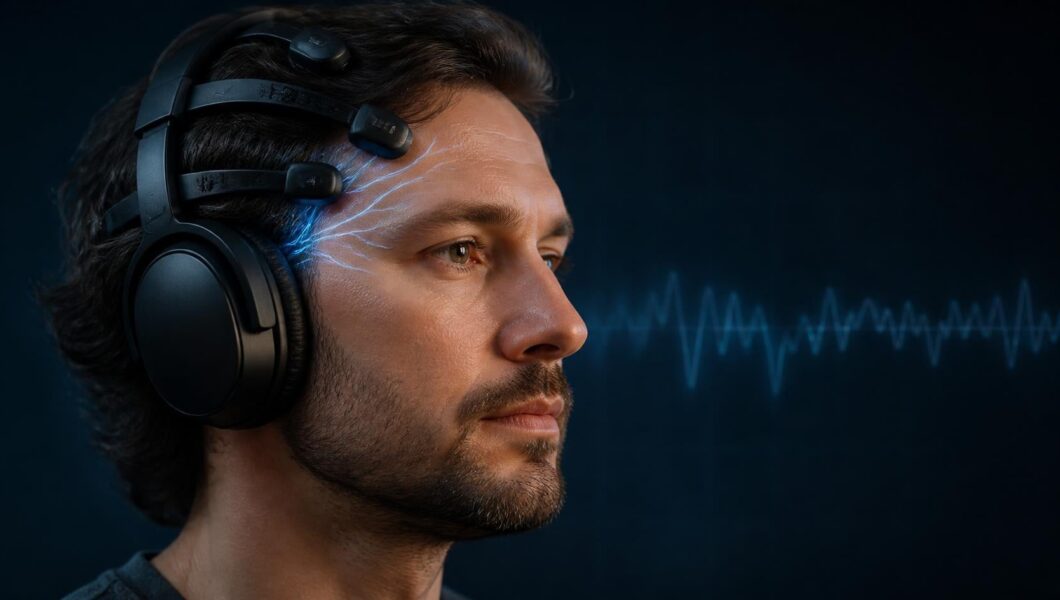
Neurotech is technology that measures, interprets or influences the nervous system, and the kind you can buy today is a wearable that picks up tiny electrical signals from your head or wrist.
Most people hear “neurotech” and picture brain implants. Those exist, but they are medical devices placed by surgeons. This guide covers the other branch: non-invasive consumer neurotech, meaning headphones, earbuds, headbands and wristbands you wear like any other gadget.
Here is the short version:
- What it is: wearables with sensors that read electrical or blood-flow signals from your nervous system.
- What it measures: patterns linked to focus, fatigue, relaxation, sleep stages, or muscle movement.
- What it does not do: read thoughts, words or private memories.
- Who makes it: a market study by the Centre for Future Generations counted 153 consumer neurotech firms worldwide, and 64% of them use EEG (source).
- Biggest caveat: consumer devices estimate mental states with fewer sensors than a hospital EEG, so treat the scores as guidance, not diagnosis.
The category is moving fast. On 1 October 2026, Neurable launched Neurable One, a pair of headphones with 12 EEG channels sewn into the ear pads (IEEE Spectrum). Earlier in 2026, NextSense put six EEG sensors into sleep earbuds (AJProTech). Meta sells its Ray-Ban Display glasses with a wristband that reads muscle signals (Meta).
Below you will find how these devices work, which ones exist, what you can realistically expect from them, and what to check about your data before you buy.
How consumer neurotech works
Most consumer neurotech works by detecting very small electrical signals with sensors that touch your skin, then using software to turn those signals into scores you can read in an app.
EEG (electroencephalography) is the most common method. Your neurons produce tiny voltage changes, and sensors on the scalp or around the ear pick them up. Brain activity shows up in rhythms. For example, alpha waves, which run at roughly 8 to 13 hertz, appear when you are awake and relaxed, and each person’s alpha peak sits at a slightly different frequency (IEEE Spectrum).
Older EEG caps needed wet gel on the scalp. Newer consumer devices use dry sensors, often made of fabric, so you can put them on in seconds. Neurable says it handles the extra signal noise with software instead of gel, and that its sensors are built into the ear pads of headphones (iMotions).
Two other signal types appear in wearables you will see in shops:
- fNIRS shines near-infrared light through the forehead to estimate oxygen levels in the frontal cortex. Muse’s newest headband combines it with EEG (Lightberg).
- EMG (electromyography) reads electrical activity from muscles, not from the brain. Meta’s Neural Band uses it on the wrist to detect small finger movements (Meta).
| Signal | What it senses | Where it is worn | Typical use |
| EEG | Electrical activity of the brain | Headband, headphones, earbuds | Focus, fatigue, relaxation, sleep |
| fNIRS | Blood oxygen in the front of the brain | Headband | Mental effort, relaxation |
| EMG | Electrical activity of muscles | Wristband | Hands-free device control |
Some earbuds and headphones also combine these inputs. Industry analysts note that a wider sensor mix can detect jaw clenches and eye movements as hands-free controls, while EEG adds information about your mental state (Neurofounders).
Why the scores are estimates: a consumer EEG device has far fewer sensors than a clinical one, it picks up more noise when you move, and its apps use models to estimate states such as focus instead of measuring them directly (AskVora).
Types of neurotech wearables (and the main products)
Neurotech wearables come in four everyday forms: headphones, earbuds, headbands and wristbands, and the form decides what the device is good at.
| Device | Form | Sensing | Main use | Notes |
| Neurable One | Over-ear headphones | 12 EEG channels in the ear pads | Focus, fatigue, “capacity” before burnout, alpha peak frequency | Launched 1 October 2026 |
| Neurable MW75 Neuro | Over-ear headphones | EEG | Focus tracking and break prompts | Made with Master & Dynamic; about $700 at launch |
| Muse S Athena | Soft headband | EEG plus fNIRS | Meditation, relaxation, sleep, focus | Made by Interaxon in Toronto |
| NextSense Smartbuds | In-ear earbuds | 6 EEG sensors | Sleep tracking and recovery | Launched commercially on 9 February 2026 |
| Meta Neural Band with Ray-Ban Display | Wristband plus smart glasses | EMG (muscle signals) | Gesture control of the glasses | $799 bundle; US release on 30 September 2025 |
Headphones. This is the easiest form to live with, because you already wear headphones for hours. At CES 2026, Neurable also showed a gaming headset made with HP’s HyperX brand that tracks focus in real time (Tech Times).
Earbuds. In-ear EEG used to be a lab experiment and is now a consumer product. Besides NextSense, IDUN Technologies builds in-ear EEG as a platform for partner brands (AJProTech). Apple has also been linked to an EEG AirPods patent, but a patent is not a product (Centre for Future Generations).
Headbands. Muse-style headbands focus on meditation and sleep. Research-style headsets such as Emotiv’s sit at the more technical end.
Wristbands and smart glasses. The Meta Neural Band is the clearest example. It senses muscle signals, so strictly speaking it reads your hand, not your mind. It still counts as neurotech because it taps the nervous system, and it matters for accessibility: EMG control can help people with limited hand function (Hiverlab).
What people actually use neurotech wearables for
The most realistic uses today are focus tracking, sleep monitoring, guided meditation and hands-free control. The scenarios below are illustrative examples, not real customers.
1. Studying without burning out. Imagine Hamza, a final-year student who studies for four hours every night. With EEG headphones, the app shows when his focus score drops and suggests a short break, then shows over a week which hours of the day he focuses best. What it cannot do is tell him what to revise. Neurable’s own small test of 20 people reported that 67% saw a focus increase, which is a company result and not independent proof (IEEE Spectrum).
2. Understanding your sleep. Imagine Sana, who works night shifts and sleeps at odd hours. Sleep earbuds with EEG sensors can show how long she spent in deeper and lighter sleep and how recovered she is. If she suspects a sleep disorder, she still needs a clinician, because consumer devices are not diagnostic tools (AJProTech).
3. Learning to meditate. Imagine Imran, who keeps quitting meditation because he cannot tell whether it works. A Muse-style headband adapts audio soundscapes to his brain state in real time, so he hears when his mind settles (Envisioning).
4. Controlling glasses with a pinch. Imagine Areeba, cooking with wet hands. With an EMG wristband, a small finger pinch can answer a message that appears in her glasses, with no touch or voice command needed (Meta).
5. Safety research. Researchers have studied EEG headphones as a way to measure drowsiness in truck drivers, including a 2022 study involving a Neurable researcher. Other real-time feedback may still be less reliable with today’s technology (IEEE Spectrum).
Privacy: who owns your brain data?
Brain and nerve signals are among the most personal data a device can collect, and the laws that protect them are new, uneven and mostly limited to a few US states.
| Law | What it does | Status |
| Colorado HB 24-1058 | Adds neural data to “sensitive data” and requires consent before processing | Signed 17 April 2024, effective 6 August 2024 |
| California SB 1223 | Treats neural data as sensitive personal information and lets consumers opt out and limit its use | Effective 1 January 2025 |
| Connecticut SB 1295 | Adds neural data to the state’s sensitive data category | Signed June 2025, most provisions effective 1 July 2026 |
| Montana SB 163 | Covers “neurotechnology data” with protections like genetic data | Signed May 2025, effective October 2025 |
| Federal MIND Act | Would direct the FTC to study neural data and recommend a national framework | Introduced September 2025; one compliance review says it was stalled in committee |
The laws also disagree on definitions. California, Colorado and Montana include data from the peripheral nervous system, which could cover a muscle-signal wristband, while Connecticut limits its definition to the central nervous system (Davis Wright Tremaine).
These are US state rules. If you live elsewhere, the brand’s privacy policy is your main protection, and this section is general information, not legal advice.
Before you buy, check these five things in the privacy policy:
- Whether your raw brain data leaves the device, and where it is stored.
- Whether the company can share or sell it, including for research or advertising.
- Whether you can use the device without creating an account.
- Whether you can delete your data, and how.
- Whether the app asks for separate consent before using your data for anything beyond your own scores.
Limits and myths: what these devices cannot do
Neurotech wearables are useful for patterns and habits, but they do not read minds and they are not medical devices.
- Myth: they read your thoughts. EEG signals cannot be translated into an inner monologue (CNN). They show broad states such as alert or drowsy.
- Myth: they equal a hospital EEG. Consumer devices sit in the consumer-electronics category, apart from FDA-cleared diagnostic systems (EEG Signal). Diagnosis belongs to validated medical equipment and clinicians (AJProTech).
- Myth: the score is the truth. Scores are model estimates. An expert quoted at Neurable’s earlier launch warned developers not to overstate what these products can do (Decrypt).
- Myth: they already detect brain disease. Neurable’s CEO has said such headphones could one day flag early signs of conditions like Alzheimer’s or Parkinson’s (CNN). Treat that as an ambition, not a feature to rely on today.
- Myth: they are comfortable for all-day wear. In a research comparison of four consumer EEG devices, participants complained about tightness and wetness after wearing them for a while, and Neurable’s headphones drew the fewest tightness complaints (arXiv study).
How to choose a neurotech wearable
Start with the job you want done, then pick the form you will actually wear every day.
| If your goal is… | Consider this form | Examples from this guide |
| Focus at a desk | EEG headphones | Neurable One, Neurable MW75 Neuro |
| Better sleep insight | EEG sleep earbuds | NextSense Smartbuds |
| Meditation and relaxation | EEG headband, with or without fNIRS | Muse S Athena |
| Hands-free device control | EMG wristband | Meta Neural Band |
Then run through this checklist:
- Define one goal. A device that tries to do everything usually does nothing well.
- Check comfort. Tightness and wetness were common complaints in a comparison of consumer EEG devices (arXiv study).
- Look for evidence. Prefer independent studies over a brand’s own small test.
- Read the data policy. Use the five checks in the privacy section above.
- Count the full cost. Include any app subscription, not only the price of the hardware.
- Ignore medical claims. If a product promises to diagnose or treat a condition, ask for proof of regulatory clearance.
- Confirm the return policy. Fit and comfort are personal, so you want a trial period.
Frequently asked questions
What is neurotech in simple words? Neurotech is technology that reads or influences the nervous system. Consumer neurotech means wearables, such as headphones or wristbands, that sense small electrical signals and turn them into scores about focus, sleep or movement.
Can neurotech wearables read my thoughts? No. They detect broad patterns, such as drowsy versus alert, and their data cannot be translated into an inner monologue (CNN).
Are EEG headphones accurate? They can show useful trends, but they use fewer sensors than clinical EEG and estimate mental states with software. Use them for habits, not for diagnosis.
Is the Meta Neural Band brain technology? Not exactly. It uses EMG to read muscle signals at the wrist, so it senses your hand movements, not your thoughts (Meta).
Is my brain data private? It depends on the brand and where you live. A few US states, including Colorado and California, now classify neural data as sensitive. Elsewhere, the company’s privacy policy is what protects you.
Are neurotech wearables safe? An expert quoted when Neurable launched its first headphones said devices that only measure EEG do not appear to carry a risk (Decrypt). Devices that stimulate the brain are a different category.
How much do they cost? Prices vary. Neurable’s MW75 Neuro launched at about $700, Meta’s glasses and Neural Band bundle costs $799, and headlines reported Neurable One at $499 (EEG Signal). Check current prices before you buy.
Conclusion
Neurotech wearables are real and improving, but their value today is in tracking habits, not reading minds. If you want focus or sleep insight, EEG headphones or earbuds are the practical choice. If you want hands-free control, an EMG wristband fits better. In every case, read the data policy before you pair the device.