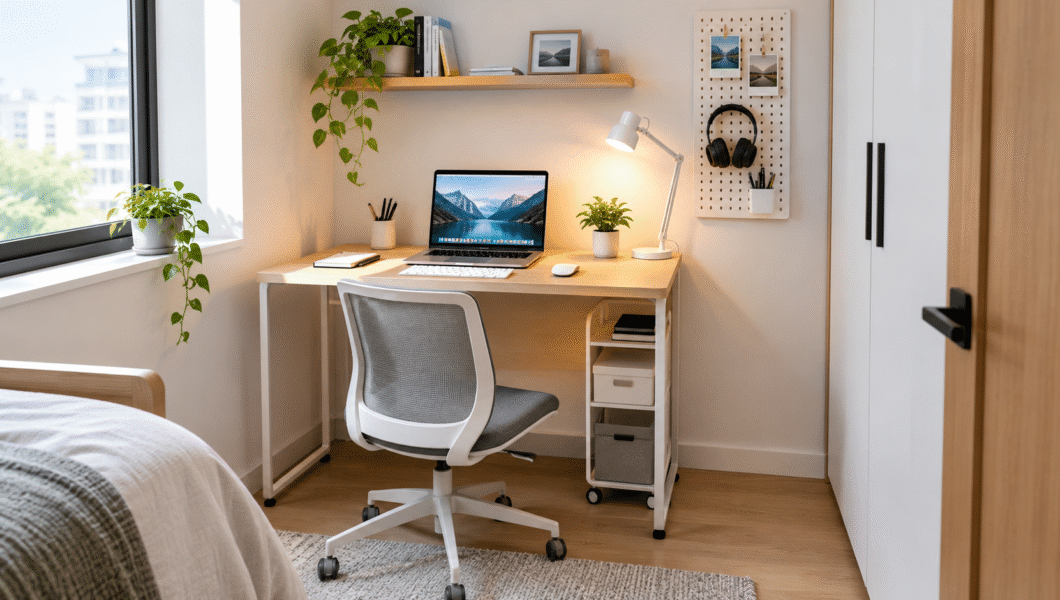
A small room doesn’t have to mean a cramped workspace. A good minimalist desk setup keeps only what you need within reach, cuts visual clutter, and makes your area feel larger and calmer. This guide covers practical ideas that work in a bedroom corner, a shared living room, or a tiny apartment.
What Is a Minimalist Desk Setup?
A minimalist desk setup uses fewer items, neutral colors, and clean lines. Everything on the desk has a job. If an item doesn’t help you work, study, or focus, it stays off the surface.
The goal isn’t an empty desk for the sake of looks. It’s a workspace where you can start working in seconds without moving things around first.
1. Choose the Right Desk Size
In a small space, desk choice matters more than anything else on this list.
- Compact desk (80-100 cm wide): Enough for a laptop, a notebook, and a lamp.
- Wall-mounted floating desk: Frees up floor space and can fold away when you’re done.
- Corner desk: Uses dead space that would otherwise go unused.
- Narrow console table: A good option if your room doubles as a living area.
Measure your space first, and leave at least 90 cm of walking room in front of the desk.
2. Use One Main Screen
Multiple monitors take up real estate. For a small space:
- Use a laptop on a stand, or one compact monitor (24 inches or smaller).
- Add a laptop stand so the screen sits at eye level, which also helps your neck and posture.
- Connect a slim wireless keyboard and mouse, so you can push them aside when you need the desk surface.
3. Go Vertical
When the desk is small, use the wall above it.
- Floating shelves for books and decor
- A pegboard for notebooks, headphones, and small tools
- A wall-mounted monitor arm, which clears the desk entirely
4. Hide Your Cables
Cables create most of the visual mess on a desk. Fixing them is cheap and makes a big difference.
- Stick cable clips along the desk edge.
- Use a cable tray or box under the desk for power strips.
- Bundle loose wires with velcro ties (they’re reusable, unlike zip ties).
- Choose wireless peripherals where it makes sense.
5. Keep a Neutral Color Palette
White, light wood, black, and gray make a small room feel more open. Add one accent color, such as a green plant or a colored notebook, so the space still feels personal.
6. Pick Lighting That Doesn’t Take Space
- A clip-on or monitor-mounted lamp saves desk surface.
- Choose warm white light (around 3000-4000K) for evening work and cooler light for daytime focus.
- Place your desk near a window when possible, since natural light improves mood and reduces eye strain.
7. Choose Multi-Purpose Storage
- A desk with a built-in drawer or shelf
- A small rolling cart that tucks under the desk
- A desktop organizer with compartments for pens, cards, and chargers
8. Limit Desk Items to the Essentials
A useful rule: only keep items on the desk that you use daily. A typical list looks like this:
- Laptop or monitor
- Keyboard and mouse
- Notebook and pen
- Lamp
- One personal item (a plant, a photo, or a candle)
Everything else goes in a drawer, shelf, or box.
9. Add a Small Plant
A small plant adds color without taking much space. Low-maintenance options include a snake plant, pothos, or a small succulent.
10. Choose a Compact Chair
A bulky chair can swallow a small room. Look for:
- An armless chair that slides fully under the desk
- A slim ergonomic chair with lumbar support
- A stool or foldable chair if the desk is only occasionally used
Don’t sacrifice comfort entirely. If you work several hours a day, back support matters more than looks.
11. Use a Desk Mat
A desk mat defines your work area, protects the surface, and gives the setup a clean, finished look. Choose a neutral color.
12. Declutter Weekly
Minimalism needs maintenance. Spend five minutes at the end of each week to:
- Clear the desk surface
- Delete unused files on your desktop
- Put everything back in its place
13. Make the Desk Multi-Use
If the desk also serves as a dining or vanity area, choose items that are easy to store quickly, such as a laptop sleeve, a small tray, or a lidded box for work supplies.
14. Add Sound Control
In shared spaces, noise-canceling headphones help you focus without needing a separate room.
15. Keep Decor Intentional
One or two meaningful items are better than many small ones. Choose pieces you actually like looking at.
Common Mistakes to Avoid
- Buying before measuring. Always check dimensions first.
- Prioritizing looks over comfort. If your back hurts, the setup isn’t working.
- Ignoring cable management. One messy cable can undo a clean design.
- Overcrowding the wall. Minimalism applies to walls too.
Frequently Asked Questions
How much space do I need for a desk setup?
A desk around 80 cm wide is enough for a laptop-based setup. Aim for around 90 cm of free space in front of it.
Is a minimalist desk good for productivity?
Many people find a clutter-free desk helps them focus, since there are fewer visual distractions. Results vary from person to person.
What is the best desk for a very small room?
A wall-mounted floating desk or a narrow corner desk usually saves the most space.
Can I have a minimalist setup with two monitors?
Yes, but it takes more space. Consider a dual monitor arm to free up the desk surface.
How do I make a small desk look bigger?
Use light colors, hide cables, keep the surface mostly clear, and add vertical storage.
Final Thoughts
A minimalist desk setup for a small space comes down to a few choices: a right-sized desk, fewer items, hidden cables, and smart vertical storage. Start with one change, such as clearing the surface or tidying cables, and build from there.