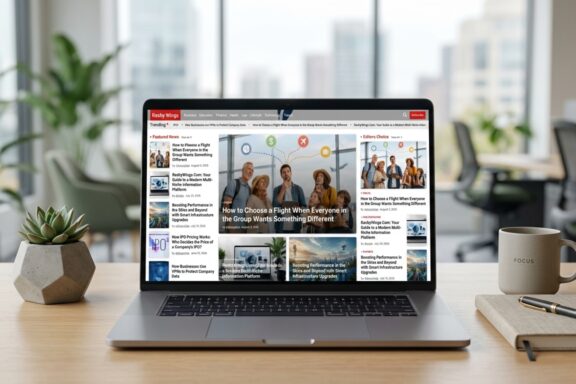
An independent look at the multi-niche publishing site: what it publishes, what it discloses, and what it leaves out. Based on the live site as checked in September 2026.
Magfusehub.com shows up in search results for an oddly wide range of topics: savings advice one day, GLP-1 medications the next, then online blackjack, then cat feeding schedules. That range is either a sign of an ambitious general-interest publication or a sign of a content site built mainly for search traffic. This review looks at what the site is, what it says about itself, and what a careful reader should notice before trusting anything it publishes.
What Magfusehub.com Actually Is
The site calls itself a “global digital media and multi-niche publishing platform.” Its About and homepage text say it covers technology, automotive, business, finance, health, lifestyle, fashion, travel, law, and pets. It looks like a standard WordPress-style content site: a trending-posts strip, a category menu, and an archive of about 60 pages.
The top navigation lists only seven categories: Technology, Business, Lifestyle, Finance, Health, Travel, and Education. Automotive, Pets and Online Games appear as labels on individual articles. Law and Fashion are mentioned in the site’s own text but not in the menu.
The self-description leans on generic phrases such as “informational accessibility,” “responsible publishing,” and “reader-focused experiences.” None of it is false, but none of it is specific either. It could describe almost any content site.
The Content Mix
Recent posts, dated April to September 2026, fall into three groups:
- General lifestyle and how-to content. Pieces like “7 Smart Ways to Build Real Savings Fast” and cat and dog care guides. Low-stakes advice in a typical content-site style.
- Health and finance explainers. Articles such as “How Long Does It Take for GLP-1 Medications To Work?” and “Can Artificial Intelligence Replace Traditional Business Insurance Brokers?” These touch on decisions that matter, which raises the bar for who should be writing them.
- Gambling and cannabis-related content. Posts on the Payz wallet at Irish casino sites, online blackjack, and THC gummy absorption (filed under Health).
None of these topics is a problem in itself, and plenty of legitimate publishers cover gambling or cannabis products. But a site that mixes medical-adjacent guidance with casino content under one first-name byline is a different thing from a specialist publication with subject editors.
Is It Technically Safe to Visit?
On the basics, yes. The site runs over HTTPS. I found no login or payment forms in normal browsing, and third-party reviews report no malware or phishing flags through mid-2026. That rules out the most common direct harms, such as credential theft and payment fraud. This can change over time, so treat it as a snapshot.
“Safe to click” and “safe to trust” are different questions, and most of what is worth examining falls into the second.
Trust Signals That Are Present
The footer links to the standard policy pages:
| Page | Present? |
| Privacy Policy | Yes |
| Terms and Conditions | Yes |
| Disclaimer | Yes, but the page content is a privacy policy |
| DMCA notice | Yes |
| About page | Yes (general, non-specific) |
| Contact page | Yes |
The homepage also says the site encourages readers to consult qualified professionals for legal, medical, or financial matters. That is a small, genuine gesture toward responsible publishing, though it appears in the homepage text rather than on the Disclaimer page.
What’s Missing
One byline across every subject
Every article and policy page I checked is credited to “Kevin.” The only bio, shown in a box on each page, is one generic line calling him a “senior staff writer & editor.” There is no surname, no credentials, no profile page, and no other named editor or contributor. Finance, health, gambling, automotive, and pet-care articles all carry the same name and the same one-line description. A publication that covers medicine and finance with authority usually names subject-specific writers or reviewers.
Why this matters: content about medication timelines or savings strategies has real consequences if it is wrong or oversimplified. Readers can’t tell whether the author has any relevant background.
A Disclaimer page that isn’t a disclaimer
The page titled “Disclaimer” is actually a privacy policy. It opens with “This Privacy Policy governs…” and says nothing about the limits of the site’s medical, legal, or financial content. For a site publishing health and finance explainers, that is the page where such a notice would be expected.
Free Gmail addresses as the only contact points
The “Editorial Office” contact is web.blogginghub@gmail.com. The Privacy Policy and DMCA pages list a different Gmail address, web.clickfor@gmail.com. For a site describing itself as a “global digital media publication,” routing editorial, privacy, and copyright-takedown requests through free consumer email accounts doesn’t match the image it projects.
No named owner or company
No registered business name, parent company, publisher, or editor-in-chief appears anywhere on the site. Combined with the single first-name byline, the operation is effectively anonymous.
A listed “Editorial Policy” that isn’t linked
The homepage and About page list an “Editorial Policy” among the site’s trust pages, but the footer links to none. I couldn’t confirm that such a page exists.
Gambling content without disclosures
In the Payz wallet article, I found:
- an outbound link to a third-party casino-listing site
- a leftover placeholder in the text (“a promo code such as XXXXX”)
- no affiliate disclosure and no responsible-gambling notice
This is consistent with affiliate-style content, though the site doesn’t state any commercial relationship.
Stock imagery
The dog-exercise article and the About, Disclaimer, and DMCA pages all use the same generic Unsplash photograph. Many article images are self-hosted uploads, and I can’t tell where those came from. Stock photos are common on small publishing sites, but this adds to the picture of a low-investment operation.
Little outside verification
Searches turned up no independent reputation profile, such as a Trustpilot listing. Third-party coverage consists mostly of generic “is this site safe” roundups, which vary widely in quality. Some similarly named domains also exist (Magfusehub.net, Magfusehubcom.com, magfusehubs.com), and their ownership relationship to this site is unclear. Don’t assume they are connected, and don’t confuse them with it.
Comparing Self-Description to Reality
| What the site claims | What’s observable |
| “Global digital media publication” | Single-byline operation, no named team |
| “Editorial consistency” and “publishing standards” | No named editors; one generic first-name byline with a one-line bio |
| “Independent digital media platform” | No disclosed owner or parent entity |
| “Transparency” and trust pages | Disclaimer page is a privacy policy; Editorial Policy not linked |
| Professional contact channel | Free Gmail addresses only |
| Broad coverage (health, finance, law) | Same byline across all subjects, no credentials shown |
These gaps aren’t unique to Magfusehub.com. The pattern is common across a tier of SEO-driven content sites. What separates a review from the site’s own marketing copy is checking the claims against what is visible.
How to Evaluate a Site Like This Yourself
- Check the padlock. HTTPS confirms an encrypted connection and nothing more.
- Read the About and Disclaimer pages closely. Look for specifics such as named people and a real company, not reassuring language. Check that each policy page actually contains what its title says.
- Look at who writes the articles. A single byline across unrelated expert subjects is a reason to weigh advice more cautiously.
- Check the contact email domain. A branded domain suggests more institutional investment than a free consumer account.
- Search the site name plus “review” or “complaints.” This surfaces user-reported issues that policy pages won’t mention.
- Notice what sits next to what. Gambling or supplement content beside health or financial advice is worth flagging, especially without disclosures.
- Cross-check anything that could cost you money, time, or wellbeing. Never rely on a single source for health, legal, or financial decisions.
The Verdict
Magfusehub.com is not dangerous in the technical sense. It runs over HTTPS, asks for no logins or payments, and there is no sign of malware or phishing. Reading a casual lifestyle or pet-care article here carries essentially no risk.
Caution is warranted on depth and accountability. The single generic byline, anonymous ownership, Gmail-only contacts, a mislabelled Disclaimer page, and gambling content without disclosures all point to a high-volume, low-transparency publishing operation rather than a specialist outlet. Treat anything touching money, medication or legal decisions as a starting point for your own research, not a final answer.
FAQs
Is Magfusehub.com safe to browse?
In the basic technical sense, yes. It uses HTTPS, shows no login or payment forms in normal browsing, and third-party checkers report no malware or phishing history as of mid-2026.
Who owns Magfusehub.com?
The site doesn’t say. No owner, company or editor-in-chief is named. Content is credited to a single first name, Kevin, with a one-line generic bio and no credentials.
Can I trust the health and finance articles?
Treat them as general-interest summaries, not expert guidance. The homepage recommends consulting qualified professionals, which is worth following given the lack of visible author credentials.
Why does the site cover gambling and cannabis products?
Both are common in affiliate-driven publishing because they can generate referral revenue. The site doesn’t state any such arrangement, but the gambling article I reviewed links to an outside casino-listing site and carries no disclosure. That isn’t automatically disqualifying, but it is a reason to read the rest of the site more critically.
How can I contact the people running the site?
Only through Gmail addresses: web.blogginghub@gmail.com for editorial and business inquiries, and web.clickfor@gmail.com for privacy and DMCA matters. No named individual is listed.