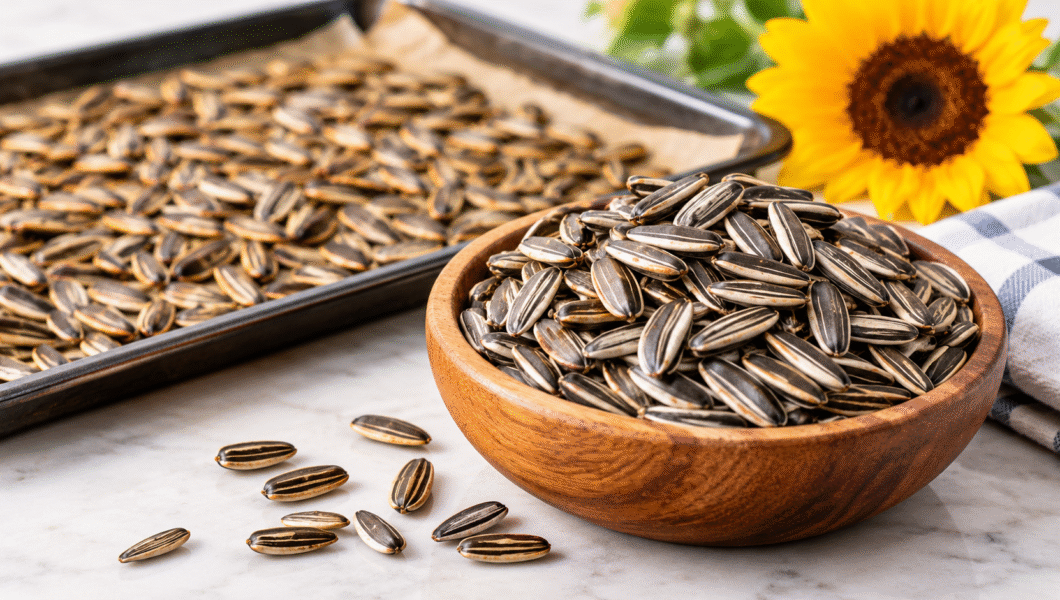
Store-bought roasted sunflower seeds are fine, but they’re often over-salted, stale, or packed with flavorings you don’t want. Roasting your own takes about half an hour, costs very little, and lets you decide exactly how salty, spicy, or plain they turn out. The main challenge is timing, since seeds go from golden to bitter in a hurry. This guide covers how I’d roast both shelled and in-shell sunflower seeds, how to season them, and how to store them so they stay crunchy.
Why Roast Your Own?
Raw sunflower seeds are mild and slightly soft. Roasting dries them out, deepens the nutty flavor, and gives them that satisfying crunch. It also gives you control over salt and oil. If you’ve got seeds from a sunflower head in the garden, roasting is also the easiest way to turn them into a snack.
Know Your Seeds
In-shell (whole) seeds:
Still wrapped in the black-and-white striped hull. They’re the classic ballpark snack and take longer to roast.
Hulled (shelled) kernels:
The soft inside part only. They roast quickly and burn easily.
Raw vs. already roasted:
Raw seeds are what you want for roasting. Pre-roasted seeds will over-brown if cooked again.
Garden seeds:
Seeds from fresh sunflower heads need cleaning and drying before roasting.
Confection vs. oil-type seeds:
Large striped seeds are best for snacking. Small black oil seeds are mostly for birds and oil.
What You Need
- 2 cups raw sunflower seeds (in-shell or hulled)
- A rimmed baking sheet
- Parchment paper (optional)
- A large bowl
- A colander
- Salt (about 1 to 2 tablespoons for brining)
- Olive oil, melted butter, or avocado oil (about 1 teaspoon)
- Seasonings of your choice
- A wooden spoon or spatula
- Paper towels or a clean kitchen towel
- An airtight container
Step-by-Step: How to Roast Sunflower Seeds
- Clean the seeds
If you’re using seeds from a flower head, rub them loose, then rinse them in a colander to remove bits of plant. Pick out any debris. Store-bought raw seeds usually only need a quick check. - Soak in salt water (optional, for in-shell seeds)
Dissolve about 2 tablespoons of salt in 2 cups of water and soak the seeds for several hours or overnight. This seasons the seeds through the shell, so the salt isn’t just on the outside. I’d do this whenever I have the time, because it makes a real difference. - Dry them well
Drain the seeds and spread them on a towel. Pat them as dry as you can. Wet seeds steam instead of roast, and they won’t get crunchy. - Preheat the oven
Set it to 325°F (165°C) for in-shell seeds, or 300°F to 325°F for hulled kernels. A moderate temperature roasts them evenly without scorching. - Toss with oil and seasoning
In a bowl, mix the seeds with a teaspoon of oil and your seasonings. Keep the oil light. Too much makes them greasy instead of crisp. - Spread in a single layer
Pour the seeds onto a baking sheet. Don’t pile them up. A single layer lets heat reach every seed. - Roast
For in-shell seeds, bake 25 to 40 minutes. For hulled kernels, bake 10 to 20 minutes. Stir every 10 minutes for in-shell seeds, and every 5 minutes for kernels. - Check for doneness
The seeds should smell nutty and look lightly golden. In-shell seeds should have shells that feel dry and crisp. Hulled kernels should be golden, not brown. If you’re not sure, I’d pull one out, let it cool for a minute, and taste it. - Cool completely
Let the seeds sit on the pan for 15 to 20 minutes. They’ll crisp up more as they cool. - Store
Once fully cool, move them to an airtight container.
Time and Temperature at a Glance
| Seed type | Oven temp | Time | Stir |
| In-shell, salt-soaked | 325°F (165°C) | 25 to 40 min | Every 10 min |
| In-shell, unsoaked | 300°F (150°C) | 30 to 40 min | Every 10 min |
| Hulled kernels | 300 to 325°F (150 to 165°C) | 10 to 20 min | Every 5 min |
| Stovetop kernels | Medium-low heat | 5 to 8 min | Constantly |
Ovens vary, so check early and often during the last 10 minutes.
Flavor Ideas
Classic salted:
Just salt and a little oil.
Ranch:
Dry ranch seasoning mix.
Smoky paprika:
Smoked paprika, garlic powder, and a pinch of salt.
Chili lime:
Chili powder and lime zest, added after roasting so they stay bright.
Cinnamon sugar:
A little cinnamon and sugar, tossed on while the seeds are still warm.
Dill pickle:
Dried dill, garlic powder, and a splash of vinegar powder if you have it.
Maple and sea salt:
A touch of maple syrup, added near the end so it doesn’t burn.
Tips for Better Results
Soak in brine for in-shell seeds:
Flavor goes deeper than surface salt.
Dry thoroughly:
Moisture is the biggest enemy of crunch.
Use a lower, steady temperature:
High heat browns the outside before the inside dries.
Stir often:
Seeds on the edges cook faster.
Season sweet flavors late:
Sugar and syrup burn quickly.
Taste before storing:
Adjust salt while the seeds are still warm.
Make small batches:
They’re best the day or two after roasting.
Common Mistakes to Avoid
Skipping the drying step:
Wet seeds turn chewy.
Overcrowding the pan:
Seeds steam instead of roasting.
Using too much oil:
They end up greasy.
Roasting at high heat:
Hulled kernels go from golden to bitter fast.
Walking away:
Seeds can burn in a minute.
Storing them warm:
Trapped steam makes them soggy.
Using already roasted seeds:
They’ll over-brown and taste bitter.
Safety and Storage Precautions
Whole sunflower seeds are a choking hazard for young children, so I’d keep them away from kids under five. Hot baking sheets and oil can burn, so use oven mitts and let the pan cool before handling. If you’re harvesting seeds from your garden, only use plants that haven’t been sprayed with chemicals, and make sure the seeds are fully dried before storing, since damp seeds can grow mold. Throw out any seeds that smell musty or look moldy. Stored in an airtight container, roasted seeds keep for about two weeks at room temperature and a few months in the fridge or freezer. People with seed allergies should avoid them completely.
Frequently Asked Questions
Do I have to soak sunflower seeds before roasting?
No, but soaking in salt water seasons in-shell seeds more evenly.
How do I know when sunflower seeds are done?
They’ll smell nutty, look lightly golden, and feel dry and crisp.
Can I roast sunflower seeds from a garden flower?
Yes. Clean them, dry them well, and roast the same way as in-shell seeds.
Why are my roasted seeds chewy?
They were probably too wet, or crowded on the pan. Dry them well and use a single layer.
How long do roasted sunflower seeds last?
Around two weeks in an airtight container at room temperature, and longer in the fridge or freezer.
The Bottom Line
To roast sunflower seeds, clean them, dry them thoroughly, and toss with a little oil and seasoning. Bake in a single layer at about 325°F, stirring often, until they smell nutty and look golden, 25 to 40 minutes for in-shell and 10 to 20 minutes for hulled. Let them cool fully before storing in an airtight container. A salt-water soak adds flavor to in-shell seeds, and keeping the heat moderate prevents bitterness. With a little attention, you’ll have a crunchy snack that beats the bag.