Molar solubility problems look intimidating the first time you see them, with their Ksp values, powers, and ICE tables. But they follow the same pattern almost every time. Once you’ve got the routine down, you can solve most of them in a couple of minutes. This guide walks through the method I’d use, shows worked examples for different salt types, and points out the mistakes that cost the most marks.
What Is Molar Solubility?
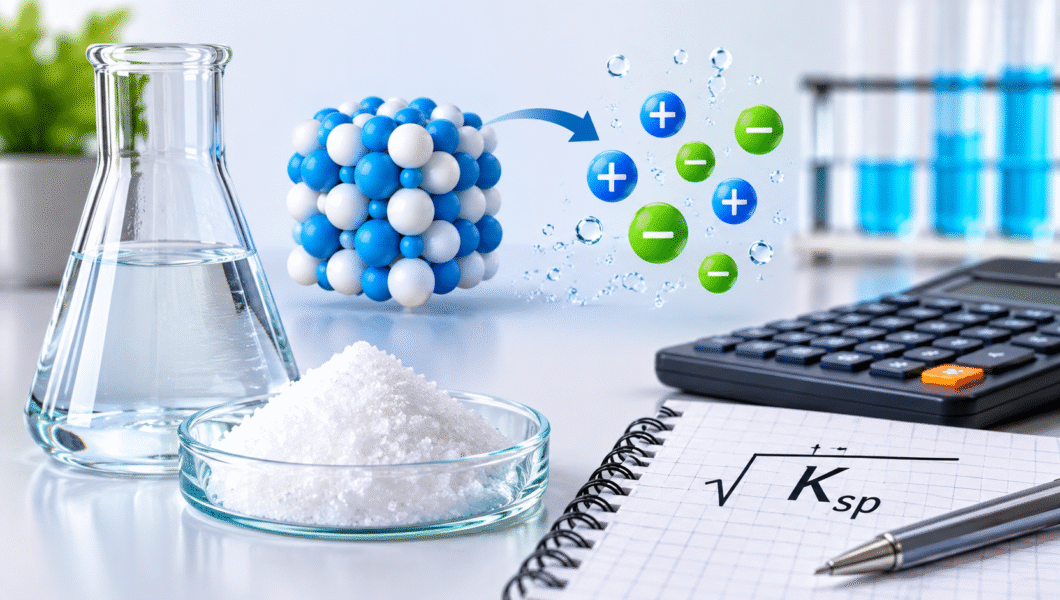
Molar solubility is the number of moles of a compound that dissolve in one liter of solution to form a saturated solution. Its unit is mol/L (M), and it’s usually written as s. It’s closely related to the solubility product constant, Ksp, which tells you how far a slightly soluble salt dissolves. A small Ksp means the salt is barely soluble.
Know the Key Terms
Ksp:
The equilibrium constant for dissolving a solid into its ions.
Saturated solution:
A solution holding as much dissolved salt as it can at a given temperature.
Dissociation:
How a salt splits into ions as it dissolves.
Common ion effect:
Adding an ion already in the equilibrium lowers solubility.
ICE table:
A tool that tracks Initial, Change, and Equilibrium concentrations.
Stoichiometric coefficients:
The numbers in front of each ion, which become exponents in the Ksp expression.
What You Need
- The balanced dissolution equation
- The Ksp value for your compound
- A scientific calculator
- Any starting ion concentrations (for common ion problems)
- The molar mass (if you need grams per liter)
- Scratch paper for your ICE table
Step-by-Step: How I’d Calculate Molar Solubility
- Write the dissolution equation
Start with the solid on the left and its ions on the right. For silver chloride: AgCl(s) ⇌ Ag⁺(aq) + Cl⁻(aq). - Set up the Ksp expression
Write Ksp as the product of the ion concentrations, each raised to its coefficient. Leave the solid out. For AgCl: Ksp = [Ag⁺][Cl⁻]. - Assign “s” to the dissolved salt
Let s be the moles per liter of salt that dissolve. Each ion’s concentration is its coefficient times s. - Substitute into Ksp
For AgCl: Ksp = (s)(s) = s². - Solve for s
Rearrange and take the right root. For AgCl, s = √Ksp. - Plug in the numbers
If Ksp = 1.8 × 10⁻¹⁰, then s = √(1.8 × 10⁻¹⁰) ≈ 1.3 × 10⁻⁵ M. - Check your answer
Make sure the units are mol/L and the size makes sense. A tiny Ksp should give a tiny solubility. - Convert if the question asks for grams
Multiply the molar solubility by the molar mass to get g/L.
Worked Example: An AB₂ Salt
Take a salt with the formula MX₂, and assume Ksp = 1.0 × 10⁻⁸ (a practice value, not a real data point).
- Equation: MX₂(s) ⇌ M²⁺(aq) + 2X⁻(aq)
- If s dissolves, [M²⁺] = s and [X⁻] = 2s
- Ksp = (s)(2s)² = 4s³
- s = (Ksp / 4)^(1/3) = (2.5 × 10⁻⁹)^(1/3) ≈ 1.4 × 10⁻³ M
The key habit here is remembering that the 2 applies to the concentration and becomes the exponent.
Formulas at a Glance
| Salt type | Example | Ksp expression | Molar solubility |
| AB | AgCl, BaSO₄ | s² | s = √Ksp |
| AB₂ or A₂B | CaF₂, Ag₂CrO₄ | 4s³ | s = (Ksp/4)^(1/3) |
| AB₃ or A₃B | Al(OH)₃ | 27s⁴ | s = (Ksp/27)^(1/4) |
| A₃B₂ | Ca₃(PO₄)₂ | 108s⁵ | s = (Ksp/108)^(1/5) |
The general rule for AₓB_y: Ksp = xˣ · yʸ · s^(x+y).
The Common Ion Effect
If the solution already contains one of the ions, solubility drops. Let’s say AgCl is dissolving in 0.10 M NaCl.
- Set up the ICE table. Initial [Cl⁻] = 0.10 M, [Ag⁺] = 0.
- At equilibrium: [Ag⁺] = s and [Cl⁻] = 0.10 + s.
- Ksp = s(0.10 + s).
- Since s is tiny compared with 0.10, assume 0.10 + s ≈ 0.10.
- Ksp ≈ 0.10 s, so s = (1.8 × 10⁻¹⁰) / 0.10 = 1.8 × 10⁻⁹ M.
That’s much smaller than the value in pure water, which is exactly what the common ion effect predicts. I’d always check the assumption afterward: if s is less than about 5 percent of the starting concentration, the approximation is fine.
Finding Ksp From Solubility
You can also work backward. If a problem gives solubility in g/L:
- Divide by the molar mass to get mol/L.
- Use that as s.
- Substitute into the Ksp expression for the correct salt type.
Tips for Getting It Right
Write the equation first:
Most errors start with a wrong or unbalanced equation.
Keep a formula sheet:
The patterns in the table repeat constantly.
Track coefficients carefully:
They affect both the concentration and the exponent.
Use scientific notation:
It keeps big powers manageable.
Check the approximation:
Common ion problems usually allow shortcuts, but verify them.
Use the right root:
Square root for s², cube root for s³, and so on.
Sanity-check the result:
Very small Ksp should mean very small s.
Common Mistakes to Avoid
Forgetting the coefficient in the concentration:
For CaF₂, [F⁻] is 2s, not s.
Forgetting the exponent:
(2s)² = 4s², not 2s².
Including the solid in Ksp:
Pure solids don’t appear in the expression.
Mixing up molar solubility and Ksp:
They’re related but not the same.
Ignoring existing ions:
A common ion changes the answer dramatically.
Using the wrong root:
Double-check the power of s.
Leaving out units:
Molar solubility is in mol/L.
Safety Notes for Lab Work
If you’re measuring solubility in a lab rather than solving on paper, follow your lab’s safety rules. Wear goggles, gloves, and a lab coat. Many salts used in solubility experiments, such as lead, silver, and barium compounds, are toxic or harmful to the environment, so dispose of them in the proper waste containers instead of the sink. Don’t taste or smell chemicals, and wash your hands afterward. If you’re ever unsure about a procedure, ask your instructor first.
Frequently Asked Questions
What’s the difference between solubility and molar solubility?
Solubility is often in g/L, while molar solubility is in mol/L.
Does a bigger Ksp always mean higher solubility?
Only when comparing salts with the same formula type. Different types need the molar solubility calculation.
Why does the common ion lower solubility?
Adding an ion pushes the equilibrium back toward the solid, as Le Chatelier’s principle predicts.
Can I use the quadratic formula?
Yes, if the “x is small” approximation fails. It’s rare for very small Ksp values.
Does temperature matter?
Yes. Ksp changes with temperature, so use the value given for your conditions.
The Bottom Line
To calculate molar solubility, write the dissolution equation, set up the Ksp expression, assign s to each ion using its coefficient, substitute, and solve. Remember to apply the right exponents, and adjust for any common ion with an ICE table. Convert to grams per liter if needed, and check that your answer makes sense. With a few practice problems and a formula table, I’d expect the pattern to feel automatic.