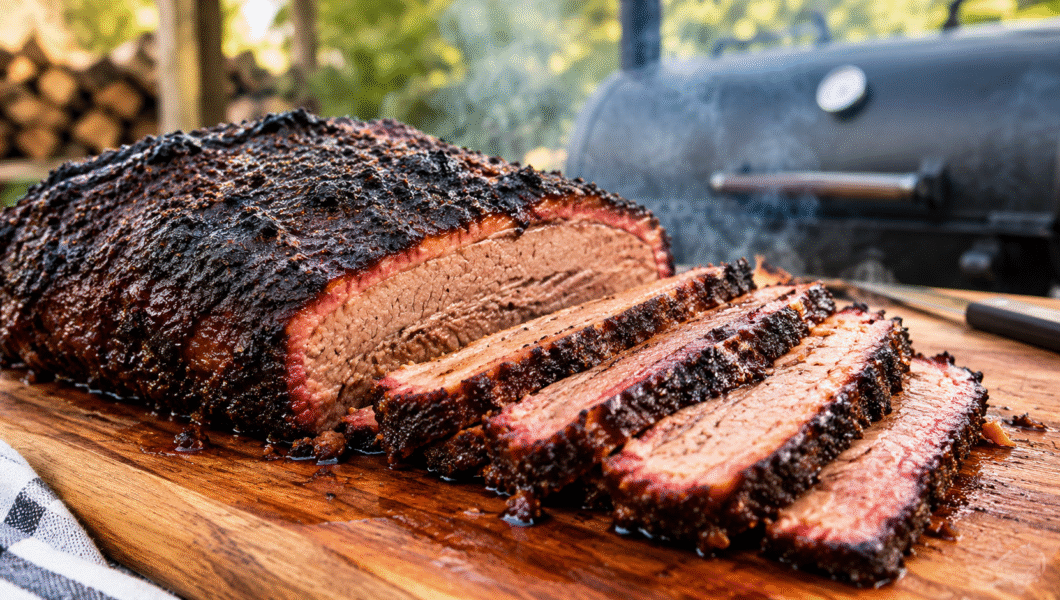
Nobody wants guests sitting around hungry while the brisket catches up. The trouble is that brisket doesn’t follow a schedule. Pit temperature, thickness, wrapping, and the stall can each shift your finish time by hours.
This guide gives you a realistic time range for 225°F, 250°F, and 275°F so you can plan ahead. Treat the numbers as a forecast, not a deadline. Tenderness decides when the brisket comes off, and rest time gets added on top.
Quick answer for a 12 lb brisket
A 12 lb trimmed packer usually needs:
- 225°F: 12 to 18 hours
- 250°F: 10 to 14 hours
- 275°F: 8 to 11 hours
Those are smoker hours only. Add at least an hour of rest afterward. In the end, a brisket takes as long as it takes.
Brisket smoking time chart
Go by the trimmed weight, not the weight on the label. If you bought a 14 lb brisket and cut away 2 lb of hard fat, read the 12 lb row.
| Trimmed weight | 225°F | 250°F | 275°F |
| 5 lb flat | 6–8 hours | 5–6 hours | 4–5 hours |
| 8 lb flat or small packer | 9–12 hours | 7–9 hours | 6–8 hours |
| 10 lb packer | 10–15 hours | 8–12 hours | 7–10 hours |
| 12 lb packer | 12–18 hours | 10–14 hours | 8–11 hours |
| 15 lb packer | 15–22 hours | 12–17 hours | 10–14 hours |
These are planning estimates drawn from hands-on experience and published guidance, not controlled side-by-side tests.
A few adjustments to keep in mind: wrapped briskets usually finish sooner, thick ones run long, and a lean pre-trimmed flat may not follow packer timing.
What a 12 lb brisket looks like at each temperature
At 225°F, expect 12 to 18 hours. For most people that means an overnight cook.
At 250°F, expect 10 to 14 hours. This shortens the cook noticeably without pushing the pit too hot.
At 275°F, expect 8 to 11 hours. It’s the fastest of the three, but the flat dries out more easily, so watch it closely.
How to tell when brisket is done
Don’t trust the clock, and don’t trust a single magic number either. Most briskets turn tender somewhere between 195 and 205°F internally. Begin checking as you get close, and pull the meat when a probe or skewer slides into the thickest part of the flat with almost no resistance.
Test the flat, not the point. The flat is the leaner muscle and the first to dry out, while the point usually softens earlier.
Don’t confuse tenderness with food safety. USDA considers whole cuts of beef safe at 145°F after a 3-minute rest, but brisket is cooked well past that because its connective tissue needs more heat and time to break down.
Time per pound
The classic rule of thumb is a decent budgeting tool and nothing more:
- 225°F: roughly 1 to 1.5 hours per pound, more if the brisket is thick or unwrapped
- 250°F: roughly 45 to 75 minutes per pound
- 275°F: roughly 35 to 60 minutes per pound
- 300°F: roughly 30 to 50 minutes per pound
A brisket isn’t a stack of identical one-pound pieces. A long, thin 12-pounder can behave very differently from a short, thick one.
Why brisket times vary so much
Thickness and shape. Heat takes longer to reach the center of a thick flat, so a blocky brisket can run long even at a normal weight.
Packer or flat. A whole packer has both the lean flat and the richer, more forgiving point. A flat alone fits more easily in the smoker but dries out faster.
Trim. A thick fat cap can slow heat in spots, while heavy trimming exposes more lean meat.
Your cooker. A pellet grill, an offset, a charcoal smoker, and a cabinet smoker all handle heat and airflow differently. Wind, cold, a leaky lid, a water pan, and opening the lid too often all change the timing.
| Usually speeds things up | Usually slows things down |
| Higher pit temperature | A thicker flat |
| Foil wrap | No wrap |
| Butcher paper (less than foil) | Frequent spritzing or mopping |
| Cold or windy weather |
Uneven airflow, unsteady pit temperature, and differences in shape and trim make timing less predictable too.
Understanding the stall
Partway through the cook, the internal temperature seems to stall, sometimes for hours. Moisture rises to the surface and evaporates, and the evaporation cools the meat the same way sweat cools your skin.
Lower pit temperatures tend to mean longer stalls. Airflow, spritzing, and mopping affect it, and wrapping shortens it by cutting evaporation. It’s completely normal. Your real decision is whether to keep going unwrapped for more bark or wrap to push through.
Wrapping: speed versus bark
Foil gives the fastest finish because it traps moisture and blocks evaporative cooling. The cost is softer bark, since the brisket steams in the wrap.
Butcher paper shortens the cook compared with no wrap but breathes more than foil, so the bark stays firmer.
No wrap is slowest and least predictable, but it builds the best bark. The flat can dry out if the cook runs long, especially at higher heat.
Brisket at 300°F
Hot-and-fast brisket runs about 30 to 50 minutes per pound, so a 12 lb packer may take 6 to 10 hours. The stall can be short or barely noticeable. If it shows up, wrapping after the bark sets helps move things along and protects the flat.
Start probing earlier than you would at lower temperatures, and still let tenderness make the call.
Rest and hot hold
Rest the brisket for at least an hour for cleaner slices and a better bite. A longer hot hold buys you extra flexibility. Use a warmer or holding oven whose temperature you’ve checked with a thermometer. A well-wrapped brisket packed in towels in a cooler works for a short rest, but it isn’t a controlled hold.
Holding safety: Keep the meat itself at 140°F or above and verify it with a thermometer. If it falls below 140°F, serve or refrigerate it within 2 hours, or within 1 hour if the air temperature is above 90°F.
If your brisket finishes early
Early beats late. Keep it wrapped and let it rest. If dinner is still hours away, move it to a verified hot hold at 140°F or higher. A tender brisket is easy to hold, but an underdone one can’t be hurried.
If your brisket is running late
First make sure it’s truly behind, because a brisket in the stall only feels stuck. Then try these:
- Wrap it. Foil is fastest, and paper keeps more bark.
- Raise the pit temperature modestly. Going from 225°F to 250 or 275°F helps without turning the cook into a sprint.
- Keep the lid closed. Every peek costs heat and time.
- Check the flat. The point may feel ready while the flat still needs time.
- Trim the rest only if you must. Skipping it entirely should be a last resort.
Whatever you do, don’t pull it just because everyone’s hungry. A tight flat won’t get tender because you sliced it early. If your serving time is fixed, build in more cushion on the next cook.
Brisket timing FAQs
How much extra time should I plan for?
Add your rest time plus a cushion in case the cook runs long. For a firm serving time, a 2-hour buffer works well if you have a tested way to hold the brisket at 140°F or above.
When should I wrap a brisket?
Wrap when the bark is as dark and firm as you want it, which often happens during the stall. Don’t decide by internal temperature alone. If the rub still smears or the surface looks wet, give it more time.
How long does brisket take after wrapping?
There’s no fixed countdown. It depends on thickness, pit temperature, the wrap you used, and how far along the brisket was. Foil cooks faster than paper. Start probing the flat as it nears the finishing range.
Can I finish a wrapped brisket in the oven?
Yes. Once the bark is set and the brisket is wrapped, move it to an oven at the same temperature, on a rimmed pan in case of leaks. Pull it when it probes tender, not at one prescribed temperature.
Can you overcook brisket?
Yes. An overcooked flat turns crumbly and dry and won’t slice cleanly. Start probing before the projected finish. A hot, tightly wrapped brisket can also keep cooking during the early rest.