If you’ve ever stared at a whiteboard covered in faint, stubborn shadows that won’t erase no matter how hard you scrub, you’ve met “ghosting” — the single biggest complaint whiteboard owners have. The good news is that most whiteboard problems, from daily smudges to years-old stains, have real solutions. This guide covers everything from quick daily wipe-downs to fixing severely ghosted boards, along with safety information most cleaning guides skip.
Understanding Your Whiteboard First
Not all whiteboards are built the same, and that matters more than most people realize.
Melamine or laminate boards are the cheapest and most common type, often found in homes and budget offices. Their surface is slightly porous, so ink from cheaper dry-erase markers can settle into tiny pores instead of sitting on top, which is what causes ghosting.
Porcelain or ceramic-coated steel boards are the premium option used in most schools and offices. Even good markers ghost faster on a lower-quality melamine surface than they do on porcelain or glass, which makes porcelain a far more resistant option over time.
Glass boards are the most ghost-resistant option available. Because the surface is completely non-porous, there are no indentations for pigment from dry-erase markers to settle into.
Knowing which type you own changes how aggressively you can clean it — porcelain and glass tolerate stronger cleaners, while melamine needs a gentler touch.
Why Whiteboards Get Ghosting
Dry-erase ink isn’t chemically all that different from permanent marker ink. What makes it erasable is one key ingredient: a release agent that forms a thin film between the pigment and the board, keeping the ink from bonding directly to the surface. As you write, the solvent in the ink evaporates, and the ink solidifies, while the release agent slides in between the ink and the board so it can be wiped away cleanly.
Ghosting happens when this system breaks down. Common causes include low-quality board surfaces, dirty or worn-out erasers, low-quality markers, erasing marks before they’ve fully dried, and heavy daily use without regular cleaning. Cheaper markers are worse offenders because their pigments penetrate the surface more easily, while quality dry-erase markers are formulated to stay on top of it.
Daily and Quick Cleaning
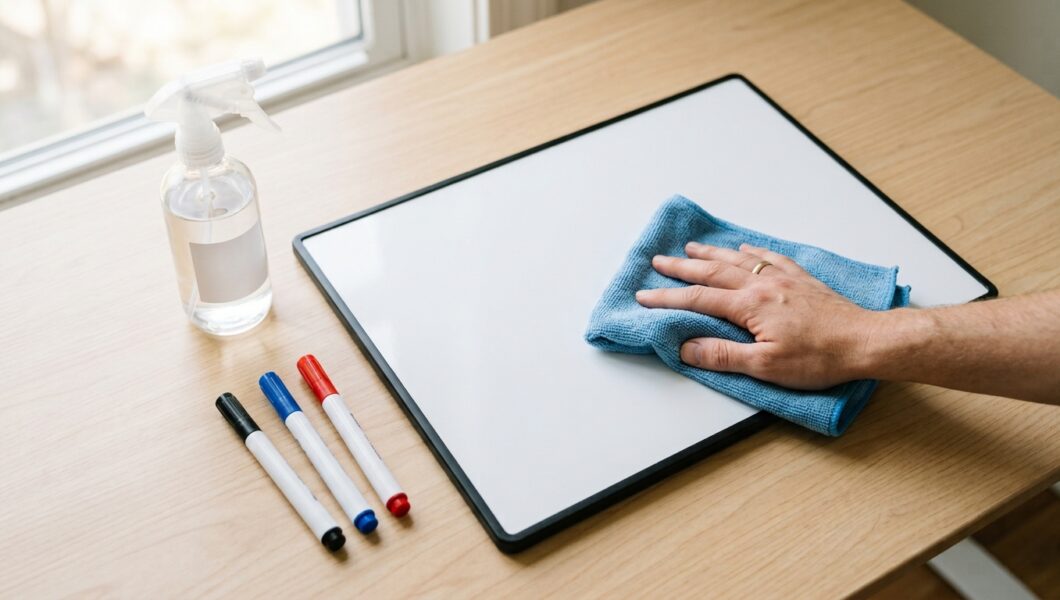
For routine upkeep, you don’t need anything fancy. Paper towels and cotton cloths tend to leave lint behind and can scratch softer whiteboard surfaces over time, while microfiber is soft, non-abrasive, and much better at lifting ink without smearing it.
For everyday use: erase normally with a dry eraser, then follow up with a microfiber cloth lightly misted with water to remove any residue. Doing this consistently prevents most ghosting before it starts — the biggest driver of buildup is letting ink sit for days or weeks before it’s erased.
Deep Cleaning: Step-by-Step
When a quick wipe isn’t enough, use this process:
- Erase normally first to remove loose, dry ink.
- Choose a cleaning solution based on how stubborn the residue is (see comparison below).
- Apply it to a cloth, not directly to the board, to avoid pooling and streaking.
- Wipe in straight, overlapping strokes rather than circles, so you don’t push residue around.
- Let it sit for a few seconds on tough spots before wiping.
- Finish with a dry microfiber pass to remove any leftover moisture or film.
Cleaning Solutions Compared
| Solution | Best for | Notes |
| Water only | Daily maintenance | Safest option, fine for light regular use |
| Dedicated whiteboard cleaner | Regular deep cleans | Formulated specifically for dry-erase surfaces, won’t leave residue |
| Isopropyl alcohol | Stubborn ghosting, old ink | Higher concentrations (90–99%) work noticeably better than diluted 70% on set-in ink |
| White vinegar and water | Light stains, natural option | Roughly one teaspoon of vinegar per cup of water for light use, up to equal parts for tougher marks |
| WD-40 | Severe ghosting, restoring old boards | Very effective, but comes with real safety trade-offs (see below) |
| Glass cleaner | Porcelain and coated steel boards | Works well on high-quality porcelain and coated dry-erase surfaces |
One important caveat: alcohol isn’t equally safe on every board type. It’s generally fine on porcelain and glass, but on melamine surfaces it should be used sparingly, since repeated use can gradually wear down the surface coating. If you’re unsure what your board is made of, test a small corner first.
A Note on WD-40
WD-40 shows up constantly in whiteboard cleaning discussions because it’s genuinely effective at cutting through old ghosting and leaving a thin protective film behind. But it’s worth knowing what you’re spraying: it is classified as an extremely flammable aerosol; its vapors can cause drowsiness or dizziness with heavy exposure, and manufacturer guidance recommends using it only in a well-ventilated area. It also carries a risk if swallowed. None of this means you shouldn’t use it — plenty of people do so safely — but it does mean good ventilation, keeping it away from heat or open flames, and thinking twice before using it in small, enclosed rooms, especially around children.
DIY Whiteboard Cleaner Recipes
If you’d rather mix your own solution:
- Alcohol spray: isopropyl alcohol combined with water in a spray bottle. For older, tougher marks, a higher concentration (90–99%) works better than a diluted version.
- Vinegar spray: one teaspoon of white vinegar per cup of water for light cleaning, or up to equal parts for stubborn residue.
- Mild soap solution: a few drops of dish soap in warm water, applied with a soft cloth, for light grease or fingerprints.
Tools: What to Use and What to Avoid
- Microfiber cloths are the gold standard: non-abrasive and lint-free.
- Felt erasers are fine for daily use, but should be cleaned or replaced regularly, since a dirty eraser grinds old ink back into the surface instead of lifting it away.
- Melamine foam sponges (“magic erasers”) can look impressive on stubborn stains, but they work through micro-abrasion — essentially very fine sandpaper. Repeated use can wear down a board’s coating, so use them sparingly, and never on glass.
- Avoid entirely: steel wool, scouring pads, abrasive powders, and any cleaner not meant for dry-erase surfaces. These scratch the coating and make future ghosting worse.
Removing Stubborn or Old Ghosting
For light, recent ghosting, a microfiber cloth with water or a dedicated cleaner is usually enough. For moderate ghosting built up over weeks or months, move to isopropyl alcohol at a higher concentration, applying it to the cloth rather than the board and letting it sit briefly before wiping.
For severe, years-old ghosting, WD-40 tends to be the most reliable fix, followed by a full wipe-down with alcohol to remove any oily residue before writing on the board again.
Removing Permanent Marker by Accident
If someone grabs the wrong marker, don’t panic. Tracing directly over the permanent marker with a fresh dry-erase marker and immediately wiping both away often lifts it, since the dry-erase marker’s solvent re-dissolves the permanent ink underneath. If that doesn’t fully work, isopropyl alcohol on a cloth is the next step.
Preventing Ghosting Before It Starts
- Use quality dry-erase markers rather than the cheapest option available.
- Cap markers immediately after use so they don’t dry out and deposit extra pigment.
- Erase writing within a few days rather than letting it sit for weeks.
- Keep boards out of direct sunlight, which can bake ink onto the surface.
- Clean on a regular schedule rather than waiting until the board looks visibly dirty.
Safety Precautions
A few basics apply across every method in this guide: use good ventilation when working with alcohol or WD-40, keep sprays away from open flames given how flammable both are, and store cleaning solutions away from young children in classroom settings. If alcohol or cleaner gets in your eyes, flush thoroughly with water. Never mix cleaning chemicals together.
Frequently Asked Questions
Does rubbing alcohol damage whiteboards? Generally not on porcelain or glass boards, but frequent use on melamine can wear the coating over time. It’s best reserved for problem spots rather than daily cleaning.
Can I use glass cleaner on a whiteboard? Yes, particularly on porcelain and coated steel surfaces, where it’s a commonly recommended option.
Is WD-40 safe for classrooms? It works well, but its flammability and ventilation requirements make it less ideal for small, enclosed rooms with children. Alcohol or a dedicated whiteboard cleaner is usually a better fit in those settings.
How often should I clean my whiteboard? Daily for heavy use like classrooms, weekly for offices, and as-needed for occasional home use.
The Bottom Line
There’s no single best cleaner for every whiteboard — it depends on your board type and how bad the staining is. For daily use, microfiber and water handle most jobs. For stubborn ghosting, isopropyl alcohol at a higher concentration is the most reliable middle ground, with WD-40 as the heavy-duty option for boards nearing the end of their life. Whatever you use, a soft microfiber cloth and good ventilation will keep both your board and your cleaning routine in good shape for years.